Friday, 2 March 2018

WHERE ARE THEY NOW/ Part 3


CARLOS GOMEZ


In this photograph the two PJI's responible for training these men are shown seated in the middle of the group. This was Free 
Fall Course number 26 and by this stage they were required to carry out 65 Free Fall parachute descents with twenty of these being done at night. Both these PJI's Sgt Dick Gledhill on the Left and Sgt Carlos Gomez on the right can be identified by their moustaches and their PJI brevets sewn onto their shirts. Both these PJI's had earned their brevets as static line instructors and had then advanced to the Free Fall role in which they both excelled..


Carlos Gomez applied to become a PJI after he joined the Rhodesian Air Force. He was originally from Mozambique but was educated in Rhodesia. He joined the Rhodesian Air Force to do his bit in the fight against terrorism and found his niche in the Parachute Training School where he was among the youngest of the U/T PJIs. Carlos was a thoughtful and mature young man who soon developed his own unique method of instruction. He was an excellent communicator and was able to influence other instructors to adopt his method with difficult students. I was still the PTS Boss when we did the 50,000th training jump and, as usual, at the time, this honour was given to the newest instructor. This happened to be young Carlos Gomez. He jumped with David Barbear, our Mascot, from 2500ft AGL with an X type parachute which had the double blank modification and the number 50,000 in black sewn onto the canopy. I asked the Dakota Captain to please land after he had dropped the Free Fall PJIs from 10,000 ft so I could present Flt/Lt Al Bruce with a bottle of champagne as a thank you from the PTS to # 3 Squadron RhAF. I lost touch with most of the PTS staff when I was posted to HQ, and then later we spread far and wide, but through the grape-vine I have heard Carlos eventually found employment with an international soft drink company and is now the General Manager in Nigeria where he has also been made an Honoury Chief of a local Tribe. If he reads this blog I hope he makes contact again.


e


The above photograph shows Sqn/Ldr  Derek de Kock presenting Flt/Lt Al Bruce with a bottle of Champagne to commemorate the 50,000th parachutist dropped in training by #3 Squadron Rhodesian Air Force. The actual 50 000th jump was carried out by Sgt Carlos Gomez the youngest PJI in the Parachute Training School at the time


MIKE WILTSHIRE

Air/Lt Mike Wiltshire practicing his sword drill before a parade. The parachute School was called upon to carry out
numerous duties which included getting dressed up in all our best uniforms and carrying swords. The one thing that seperated the PJI's from the rest of the Air Force was our head dress. PJI's wore the Beret and the rest of the Air Force wore Caps.


This photograph shows a wings parade for an SAS course which had just completed the parachute jumping course and it also provided the opportunity for the U/T PJI's to receive their PJI Brevet. Three of the new PJI's are seen in the rear rank and are from R to L Sgt Mike Wiltshire, Sgt Iain Bowen and Sgt Dennis (Charlie) Buchan. The fourth new PJI Sgt Ralph (The Rat)Moore is hidden behind Mike Wiltshire.


This photograph shows Mike trying to look fierce while teaching or being taught unarmed combat. It just shows the versatility of the Parachute Training School. The only trained soldiers in the Rhodesian Air Force were in the Parachute Training School and this resulted in the staff of the PTS being called upon to carry out most of the Brown Job (Rhodesian Army nick name) tasks that occurred from time to time.


This photograph shows Mike Wiltshire hitching a ride in a Chopper possibly to retrieve a parachute from the top of a gumtree where he had dropped a soldier doing a night jump. Mike was one of those men who could charm his way-out of any jamb. On this occasion he was giving instruction's to the dropping aircraft from the DZ  and tried to drop the stick of paratroops as close to the retrieval trucks as possible but forgot about the very tall gumtrees nearby. One soldier got hung up more than 60mts above the ground and the Fire Brigade was called in to get the soldier down. The next morning Mike spoke very nicely to #7 Sqn and borrowed a chopper and pilot to retrieve the parachute. He was a charmer.


A wet Mike Wiltshire being rescued after a parachute jump into Lake McIlwaine. These water jumps were laid on from time to time for the Rhodesian Air Force Air Crew and it also gave those injured PJI.s and various VIP's a chance to enjoy a frightening experience. 

Mike Wiltshire  Joined the Parachute Training School straight from civilian life, but I seem to recall he was an Air Cadet in the Royal Air Force where he’d learned how to march and who to salute. He was a Londoner and had worked on the London buses, at first as a conductor and later as a driver. He was a witty raconteur and some of the tales he told kept the staff of the PTS in fits for days at a time. He was also very handy to have around when a Dakota got a bit shot up. Once, for example, the battery compartment was smashed in a dust-up. The Dak engineer and Mike borrowed a couple of Land Rovers and, by joining the two batteries in series, managed to start the Dakota so it could be flown home for repairs. Mike was also responsible for creating our own flying canons. He got 4 MAGs (.762 mm machine guns), made a framework for the guns from angle iron and other bits of steel, and mounted it in the door of the Dakota. This took place in the Mtoko area - the SAS were operating over the border and required resupply on a weekly basis. Every time this resupply took place the Dakota doing the drop was fired at by some heavy machineguns. This seriously pissed Mike off and he determined to shoot back. Hence his version of Puff the Magic Dakota Dragon. Apparently they fired this contraption one night. The results were not as expected – with all the fire-power the Dakota became a more visible target and the ground fire became much more accurate. This did not please the two pilots up front especially when lots of green lights started to flash past their windows. The other problem was the doppies (empty cartridge cases) which soon became a menace in the back of the Dakota. Mike had the greatest sense of humor amongst a staff who would always find the funny side of any situation. He was also a great prankster. Just one example, when he was picking up members of PTS staff from their homes in the very early hours of the morning, he decided to wake up everybody in the neighborhood by pretending to be the police. He used one of our loud hailers, shouted to Iain Bowen to come out with his hands up, then bundled him into the back of the van and roared off down the street. Vera Iain's wife was not happy. It caused a lot of consternation in the neighborhood. Mike was a natural leader who was able to gain the respect of the men under his command. He seemed to find the easy way of doing things and appeared confidant and cheerful even under the most trying conditions. He was awarded the Military Forces Commendation Operational for the part he played on numerous Fire Force Operations where his calm and cheerful attitude inspired his troops. Mike Wiltshire was one of my officers and I was able to trust him implicitly to get the job done. I was honored to know him RIP


A few more PJI stories are still to be told and I hope to include a tale or two from the pilots who dropped us and I would like to include a soldier's story or two. 


Thursday, 22 February 2018

THE PJIs WHERE ARE THEY NOW ? part 2


PAUL HOGAN


The Rhodesian Air Force Parachute Training School's very own Australian. Sgt Paul Hogan was an extraordinary instructor who proved his ability as a PJI when teaching parachuting to the warriors of the Rhodesian African Rifles (RAR), who performed magnificently on the Parra Fire Forces.  


Sgt Paul Hogan about to sneak  an Operational Jump on Fire Force in 1978. I know all the PJI's did this against my orders because I was very short of PJI's and I could not afford to have them injured buggering about trying to play at soldiers. I told all the PJI's that if they wanted to play at soldier I could arrange for a transfer to the Army. But you cannot stop a warrior from trying.


 Paul Hogan was born in Australia and became a miner. He decided to visit Rhodesia where he found employment on a mine but saw an advert in a newspaper for people to train as Parachute Jumping Instructors. Paul was a keen sky diver and decided to sign up. He soon learned that it was not a case of merrily hurling himself out of an aircraft whenever he felt like it. He had to learn to teach and gain the confidence of his pupils. Paul mastered the teaching technique and became one of the senior PJIs responsible for instructing U/T PJIs later on. Paul was also responsible for the development of various Free Fall Techniques including the dive exit. He returned to Australia with his partner and daughters and they settled in Busselton Western Australia where he carried on with his mining career on a fly-in-fly-out basis. Paul purchased a Sky Dive School and ran this enterprise when he was at home during breaks from mining. In 2008 Paul invited all ex Rhodesian PJIs to assemble at Busselton for a reunion. It was during this reunion that a book on the history of the Rhodesian Air Force Parachute Training School was raised. Peter Garret was going to put the book together but things changed for him and this task fell to me, hence this blog. Last I heard, Paul was/is operating his own Gold Mine in the West Australian Gold Fields. 


DENIS BUCHAN


The above photograph shows a basic static line course with the PTS  staff seated in front of a Dakota. Seated and looking very dapper LtoR Denis (Charlie) Buchan, Derek de Kock, Frank Hales, Iain Bowen. This I believe was the last jump for our mascot 0001 Sgt Fred Bear who jumped with Denis (Charlie) as a drifter for number 42 Basic Static Line course. Fred was retired after this jump having completed 144 descents but had sustained too many  injuries  that had required major surgery to replace his head and arms a few times. 


Denis (Charlie) Buchan
 joined the Parachute Training School after the call went out to the Army for volunteers to become PJIs. Charlie had served with the British SAS in Borneo, Yemen and Northern Ireland. He was a Corporal when he came to PTS and very soon picked up the necessary techniques to become a PJI. He is short in stature with a good head of grey hair. (I think he was born with lots of grey hair) and, according to the latest photos I’ve seen, he still has a full head of hair. It was soon apparent to me, and my second in command, Frank Hales that we had an excellent instructor in Charlie. He was one of those people who always looked neat and unflustered. He even looked neat when he was covered in dust and dirt. He could also give the most competent instruction on how to make a rat pack, not only edible, but gourmet. In addition, he also taught the workings of all the military weapons we had including the communist ones. He astounded Max Caton the Station Armament Warrant Officer with his knowledge when called upon to give an impromptu class on the workings of a 36 grenade. Charlie was later Commissioned and became an Operations /Training Officer at PTS. Charlie was also an exceptionally brave and quick-thinking man. Once we were trying out from what distance we could hear an Alouette helicopter attempting to sneak up on us. As the helicopter skimmed over a large dam it flew into an illegal power cable and crashed into the water. Charlie was on board the helicopter. He managed to undo his harness and swim to the surface when he noticed the pilot was struggling to get out of his seat harness. Without a second thought for his own safety Charlie dived down, released the pilot and helped him to shore. Charlie was awarded the Commander’s Commendation for this action. Soon after I was posted to Air Force Headquarters Charlie opted to return to the Rhodesian SAS. where he carried out a number of clandestine operations in Mozambique. After the cease fire Charlie and his family moved to South Africa where he settled. I have no knowledge of what employment he undertook in South Africa. He is now retired and lives in the Drakensberg Mountains at Underberg with his wife Doreen and he continues to enjoy training his dogs.


IAIN BOWEN


Sgt Iain Bowen being presented with his PJI brevet having completed his PJI course and transferred to the Rhodesian Air Force Parachute Training School in 1971. 


This photo shows Iain dressed as a PJI wearing flying overalls and a free fall parachute rig with his PJI  bone dome complete with his name and his medics red star emblazoned on the front. 


Sgt Iain Bowen pretending to fall out of the Dakota except he has a big smile on his face. Just as well we had a sense of humor in the Parachute Training School as life would have been rather tedious without one. 


Iain Bowen  When we advertised for volunteers to become Parachute Jumping Instructors we specifically targeted the junior NCOs. They were younger and, if chosen, would be promoted to Sergeant – a great incentive. In the Parachute Training School we already knew the SAS soldiers who liked to hurl themselves out of a Dakota in the early morning. It was, therefore, absolutely no surprise to find L/Cpl Iain Bowen in the PTS hangar wanting to try his hand at becoming a PJI. Iain soon found jumping out of the Dakota was the easy part of being a PJI -learning to teach other people to jump was a little more difficult. Iain struggled to instruct in the beginning of his course but, through persistence and a great willingness to learn, he mastered the technique and became a great PJI. I am certain he is well remembered by all his students for his clear and authoratative instruction. As a Sgt PJI Iain married the only girl in his life Vera, at the RLI Chapel. All the PJIs formed a guard of honour with umbrellas and a very memorable party was held in the New Sarum Sgts’ Mess afterwards. After a number of years as a PJI Iain felt the call of the SAS and returned to the unit and jumped on operations including the large 23 man free fall jump from the DC7 into the Gaza province of Mozambique. Iain came back to PTS and was deployed on Fire Force with the RAR where his skill as a paramedic was put to good use. After hostilities ceased and the country became Zimbabwe, Iain went to the UK where he found employment as a salesman for plumbing supplies. It was a horrible job. Luckily, one day he was having lunch in a pub when he found himself talking to an ambulance para medic and discovered he was actually better qualified. This medic told Iain that there was a shortage of paramedics in that area of the UK and he should apply. Iain did and was immediately accepted, but in the UK there is always a but. The UK weather leaves a lot to be desired so Iain began to look for other places to settle. He had a sister in Australia, living in Canberra who encouraged them to migrate to Aus. Iain’s qualification as a paramedic in the UK was accepted in Australia and there would be a job for him when he arrived. The Bowen family settled in Canberra where Iain worked as a paramedic but after a time he found the outback calling. He and Vera purchased a property near the small town of Texas in Southern Queensland and began to farm cattle. Iain also found work as a paramedic with the ambulance service of Queensland. After a time Vera found the cattle business very hard work with little reward and the Bowens retired to the town where they quickly became part of the community with Vera growing huge zucchinis and other vegeatables and Iain joining the local hunting and shooting clubs.


KEVIN MILLIGAN


!9 Sept 1974 Sgt Kevin Milligan being presented with his PJI Brevet by the Station Commander New Sarum Gp Capt J. Mussel. Kevin later became the Commanding Officer of the Zimbabwe Parachute Training School.


Kevin Milligan was born and raised in the UK . He first came into contact with the Rhodesian PJIs at RAF Abbingdon in 1961 where he completed his basic parachute course, - in a coincidenced Sgt Norman Suttie, RRAF, signed his log book. At the time Kevin was serving with the British Parachute Regiment. A few years later, he and his wife Angie went to Zambia where Kevin worked on the copper mines. There, he helped to start up a sky-diving club and did a number of parachute jumps at local agricultural shows. He was even responsible for making the Zambian President wait a good ten minutes whilst the dropping aircraft climbed to altitude. In about 1973 Kevin and Angie moved to Rhodesia where Kevin again worked in mining. Soon after their arrival Kevin saw an advert in the local press - The Rhodesian Air Force was looking for volunteers to become Parachute Jumping Instructors. Kevin applied and soon found himself dressed in Air Force Blue doing a basic parachute course which was much the same as the one he had already done at RAF Abingdon except we carried weapons on the body, instead of in a suspended load as they did in the UK. At this time we were still only training the SAS but we were doing Free Fall courses at an increasing rate and the time soon followed when we started training the Selous Scouts. Kevin found his true calling - teaching soldiers how to parachute. He was a natural leader and, as more and more courses came through the PTS, Kevin was commissioned as an Air Lt. and filled the Operations Officer/Training Officer post. This involved keeping the three Fire Forces supplied with parachutes and making sure the PJIs had time at home. He was also carried out some HALO drops which involved the final navigation to target and ensuring the accuracy of the drop – all of which he managed with great skill. After the Zimbabwe independence, Kevin remained in the Zimbabwe Air Force and became the Commanding Officer of the Parachute Training School. After ten years of service Kevin retired from the Zimbabwe Air Force and returned to the Mining Industry for a number of years. Eventually Kevin and Angie returned to Ireland where Kevin started his own business. Unfortunately Angie passed away from cancer. Kevin also suffered from colon cancer but it appears he has mastered the problem and seems to be enjoying good health now. Well done Kevin. Keep it up!


Friday, 16 February 2018

THE PJIs WHERE ARE THEY NOW ? Part 1


THE RARE BREVET

THE FOLLOWING IS A LIST OF PARACHUTE JUMPING INSTRUCTORS WHO ARE ENTITLED TO WEAR THE RHODESIAN AIR FORCE PJI BREVET AND WHERE THE AWARD TOOK PLACE 

NAME                                                            DATE                            LOC OF TRAINING 
M.J. Swart                                   Dec 1963                     PTS RRAF New Sarum
D.J.G. de Kock                            Aug 1961                     PTS RAF Abingdon U.K.
W.P. Maitland                              Aug 1961                     PTS RAF Abingdon U.K.
T.P. Smith                                    Aug 1961                      PTS RAF Abingdon U.K.
Norman. Suttie                            Aug 1961                      PTS RAF Abingdon U.K.
Frank Hales                                 Sept 1963                      PTS RAF Abingdon U.K.
Tony Hughes                               April 1966                     PTS RRAF New Sarum
Dennis Buchan                            Sept 1971                      PTS RhAF New Sarum
Ralph Moore                               Sept 1971                      PTS RhAF New Sarum
John Boynton                              Sept 1971                      PTS RhAF New Sarum
Mike Wiltshire                            Sept 1971                      PTS Rhaf New Sarum
Iain Bowen                                  Sept 1971                      PTS Rhaf New Sarum
Kevin Milligan                            Sept 1974                      PTS RhAF New Sarum
Paul Hogan                                  Sept 1974                      PTS RhAF New Sarum
Pete Marshall                              Sept 1974                       PTS RhAF New Sarum
John Early                                   Sept 1977                       PTS RhAF New Sarum
Chris Pessara                               Sept 1977                       PTS RhAF New Sarum
Andy Stein                                   Sept 1977                      PTS RhAF New Sarum
Billy Simpson                              Sept 1977                      PTS RhAF New Sarum
Roy Tidman                                 Sept 1977                      PTS RhAF New Sarum
Pete Labuschagne                        Sept 1977                      PTS RhAF New Sarum
Pete Waite                                    Sept 1977                      PTS RhAF New Sarum
Frank Pendergast                         Sept 1977                      PTS RhAF New Sarum
Fred van der Weer                       Sept 1977                      PTS RhAF New Sarum
John Mellett                                 Sept 1977                     PTS RhAF New Sarum
Mike Duffy                                  Sept 1977                     PTS RhAF New Sarum
John Bolton Smith                      June 1978                      PTS RhAF New Sarum
Dick Gledhill                               June 1978                     PTS RhAF New Sarum
Carlos Gomez                              June 1978                     PTS RhAF New Sarum
Mike Kemmish                            June 1978                     PTS RhAF New Sarum
Chris Francis                                June 1978                     PTS RhAF New Sarum
Ralph Gratton                              June 1978                    PTS RhAF New Sarum
Rich Griffin                                 Oct 1978                      PTS RhAF New Sarum
Pete Farmer                                  Oct 1978                         PTS RhAF New Sarum
Alf Hynds                                     Oct 1978                      PTS RhAF New Sarum
Ken Turner                                   Dec 1978                      PTS RhAF New Sarum
Ian Douglas                                  Dec 1978                      PTS RhAF New Sarum
Trevor Williams                           Dec 1978                      PTS RhAF New Sarum
Norman Mayne                            Dec 1978                      PTS RhAF New Sarum
Roy Johnson                                 Dec 1978                      PTS RhAF New Sarum


The above picture of the Rhodesian Air Force Parachute Jumping Instructor Brevet was issued to all the men listed above on the successful completion of their PJI course. The Brevet was worn on the left breast above any medals or decorations in the same manner as other aircrew insignia.

In 1970 the Royal was removed from the Royal Rhodesian Air Force when Rhodesia became a Republic. Soon after the proclamation it was decided to change all the aircrew flying badges. In the case of the Pilots’ aircrew wings, and the Navigator’ half wing, they simply removed the crown from above the Rhodesia Coat of Arms and replaced it with the Lion and Tusk insignia. The shape of the actual wing was changed from the Royal Air Force shape to the Rhodesian Bataleur Eagle shape. The size of the Pilots’ wings and the Navigator’ half wing remained the same.

For some reason, and much to our chagrin, the Parachute Jumping Instructor half wing was reduced in size to about three quarters of the original RAF half wing. At the time the following RhAF PJIs were entitled to wear the RAF PJI Brevet; Sqn.Ldr Boet Swart,(Boet returned to Army in 1969), Sqn.Ldr Derek de Kock, Air Lt. Frank Hales, Air Lt  Bill Maitland (posted to GSU 1969), W.O. Trevor Smith, Flt. Sgt Tony Hughes and W.O. Norman Suttie. Norman Suttie had returned to his Equipment Trade but was available for call back to PTS as required.

Objections were submitted, (loudly) to Air Force Headquarters about the reduction in size but orders were received to change to the new brevets as mandated, and to "shut up". It must be remembered that those PJIs who were awarded the RAF PJI brevet were qualified by the Royal Air Force – perhaps this fed into what we saw as a total lack of respect from the higher-ups. The Rhodesian Air Force PJI Brevet has always been omitted from posters depicting the Rhodesian Air Force flying badges and ranks. Only 40 RhAF PJI brevets were ever issued - this must then make it one of the rarest combat parachute badges in the world. Another reason for this attitude is that in 1970 or thereabouts, the pilots in the Air Force thought of us, and actually called us, “MEAT BOMBS”.


I am sorry to say that this Royal Air Force Parachute Jumping Instructor Brevet is a little tatty but it gives an indication of its shape and size compared to the later Rhodesian PJI Brevet. In 1961 these brevets were presented to the five Rhodesian PJIs trained at RAF Abingdon. We were then required to train two courses of The Parachute Regiment before we returned to Rhodesia to start training the Rhodesian SAS. We were good at this parachuting business and remained so for the next 19 years. 
 Unfortunately, I have not kept up with all the Rhodesian PJIs – following is the fate of only some of those I had the honor to work with.


This photograph is of Boet on his basic course wings parade where he is seen in the uniform of the Kings African Rifles (Later the Rhodesian African Rifles) He is seen talking to the reviewing officer with the then OC PTS in the background Flying Officer R.T.D. Smith BEM RAF and Flt Sgt Robinson BEM RAF acting PTS Warrant Officer in the foreground.


This photograph shows the PTS staff after the RAF secondments had returned to the  U.K. seated from LtoR 
Sgt Frank Hales,  W.O.1 Bill Maitland,  Sqn. Ldr. Boet Swart, Flying Officer Derek de Kock  Sgt Trevor Smith.
This is a course photograph taken in about 1964


This photograph shows Boet dressed in all his finery,  as the President of  The Officers Mess, guiding the Rhodesian Air Force Commander Air Marshal A.O.G. Wilson and the President of Rhodesia The Honorable Clifford Dupont into dinner at the Officers Mess New Sarum

Boet Swart died in Kimberly, South Africa after serving with the Selous Scouts and the South African Special Forces. Boet first came to PTS on basic static line course number 3 in 1961 as a Captain in the Federal Army. Boet completed this course despite an injured coccyx. We in PTS forgot about this particular officer as we were inclined to do after every wings parade, but about a year or so later Boet suddenly appeared as a Flt/Lt in PTS and needed to be taught how to be a PJI. At the same time I was sent off to the RAF for training to become an Officer. Boet was one of  those people who could fit into any gathering of men and lead them in a short time. He took command of PTS as a Squadron Leader in December 1963. Boet soon made himself known in the Air Force and volunteered the services of PTS to teach the Air Crew how to survive in the bush. He and the PJIs, especially Frank Hales, soon dragged the Pilot cadets through the wilds of Rhodesia and taught them to squeeze water from the stomach contents of an antelope they'd just shot. I believe that the Rhodesian Air Force needed a man like Boet to do all those jobs that were too dirty for the Air Crew officers to do, like survival training, building rifle ranges and then running the annual President's Medal shooting competition, building the chalets at the Air Force Welfare Site, filling in as O.C. Admin Wing or Station Adjutant, training airmen how to be soldiers in fact any of the many jobs other than flying. During his time as O.C. PTS Boet stated quite emphatically that he hated parachuting and would only jump when the weather conditions were perfect. He did manage to accumulate 99 X type jumps before he retired from the Air Force in 1969.  He was awarded the MFC Military Forces Commendation - non op) .Boet then rejoined the Rhodesian Army and was in the RLI for a short time as a Major. When the Selous Scouts were formed Boet joined the unit and was awarded the OLM (Order of the Legion of Merit).  Boet returned to South Africa where he joined the Special Forces and served until his retirement


The above photograph is of Frank Hales (nearest the camera ) and Boet Swart  dressed in their survival gear waiting for the Air Crew Cadets to show up. This was about 1966 and was before the terrorist war became extremely hot. The courses in those days was run in the sparsely populated low veld area of Rhodesia.  Hot and dry at times  

 Frank Hales died in Durban South Africa soon after his wife Freda passed away. Frank was the ultimate instructor and leader, always ready to share his knowledge. Frank joined the British Army as a boy soldier and saw service in the Korean War where he served with British Artillery. He later joined the British SAS and saw service in Borneo where he was mentioned in dispatches. He joined the Rhodesian Army and he and his wife Freda moved to the Federation in about 1960 and were stationed with the Staff Corps in Bulawayo. When a vacancy occurred in the Parachute Training School in 1963, Frank put up his hand, was accepted, and completed his PJI training at RAF Abingdon UK. He later became the Training Officer/Chief Instructor and finally the Commanding Officer in 1979.In 1977 Frank returned to the Rhodesian SAS and completed a tour on SAS operations where he was awarded the right to wear his SAS wings on his chest for incredible service, he was also awarded the DMM for the development of Free Fall Techniques in the Parachute Training School.  


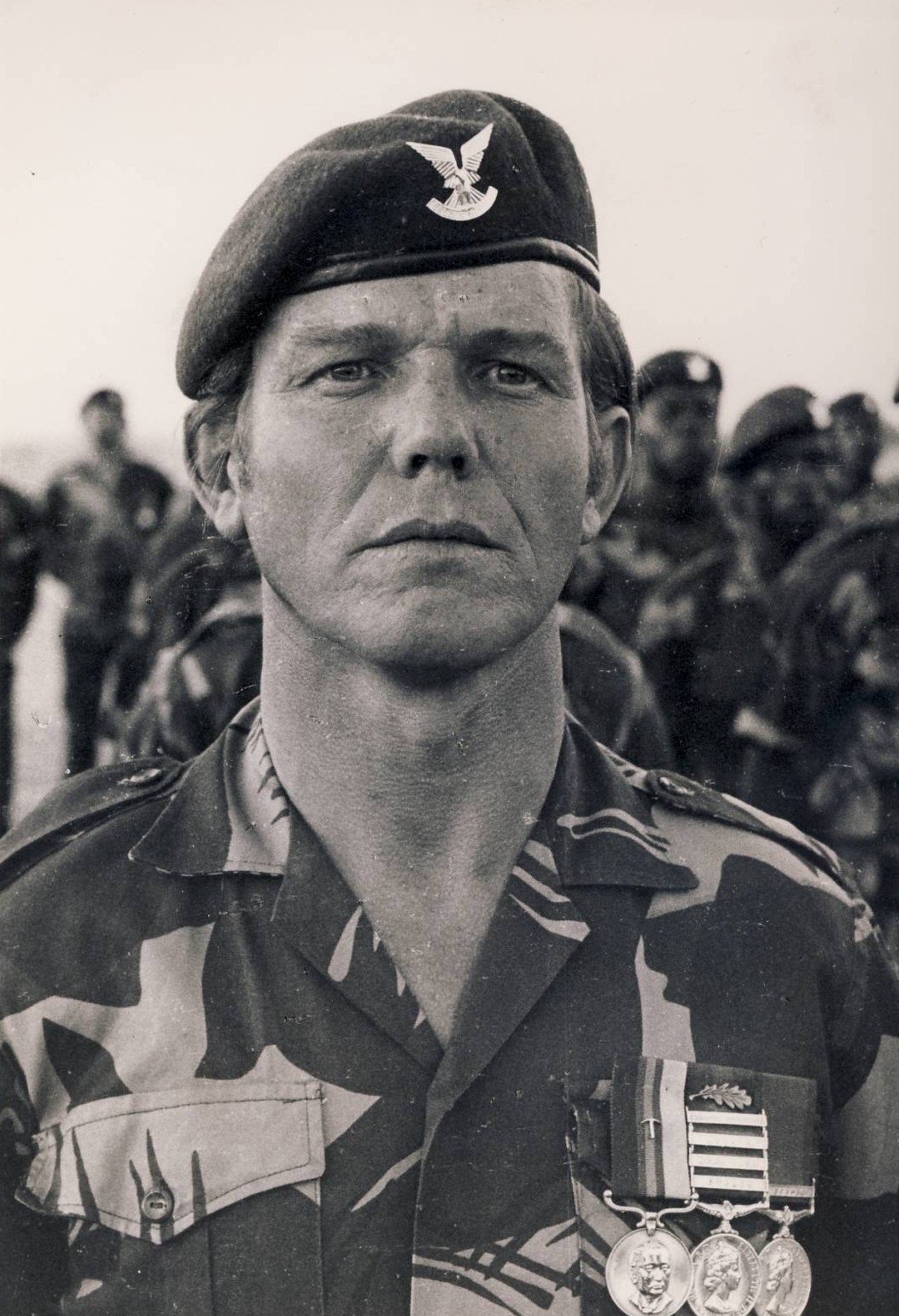
The above picture is of Ralph (the RAT) Moore in the uniform of a Selous Scout with his medals showing British medals with the MID (Mentioned in Dispatches), and the Rhodesian general service medal showing the gold pick depicting his award of Military Forces Commendation Operational  

Ralph Moore (The Rat) died in South Africa after serving in the Selous Scouts and the South African Special Forces. Ralph The Rat, as he was affectionately known, had a remarkable military career, He jumped into Egypt in the 1956 Suez crisis with the Parachute Regiment and was mentioned in dispatches. He joined the British 22nd SAS and saw service in Borneo and the Yemen, then joined the Rhodesian SAS for a while. He transferred to the Rhodesian Air Force Parachute Training School in 1971 where he qualified as a PJI. He stayed in the PTS until 1979, when he transferred to the Selous Scouts. As soon as Rhodesia became Zimbabwe Ralph moved to South Africa and joined the South African Special Forces. Ralph The Rat was a true warrior and served with absolute distinction. Ralph was awarded the MFC Operational for his service on Fire Force as a PJI.   


This is a great photograph of Warrant Officer John Boynton the PTS W.O. (same as RSM in the Army). John was an extremely accomplished combat medic. and was responsible for discipline in the Parachute Training School, a role he achieved with a mere look and shake of his head

 John Boynton joined the British Army and trained as a paramedic in the Parachute Regiment. He was also an accomplished boxer. After completing his British Army service he was recruited into the RLI but before he actually started serving with them he discovered the PTS was looking for PJIs. He qualified as a PJI and served with the PTS until it changed to Zimbabwe. John Boynton moved to South Africa and served with a parachute battalion. He later joined a security company in Durban and I believe he was murdered whilst on duty. 


Warrant Officer A B Hughes  being  rescued after one of his many water Jumps. Tony was a great asset to the Parachute Training School because he always made himself available when we were desperate for PJI's to mann Aircraft  on large operational across border  parachute drops he was awarded the M.F.C. for his duty to parachuting

Tony Hughes joined the RRAF and trained as an Air Radio Fitter. When Mercer Thompson badly injured his arm doing a sky dive with the local civilian Sky Dive Club a vacancy occurred in the Parachute Training School. After completing his PJI training Tony was awarded his PJI brevet in 1966. Subsequently Tony was also injured doing a parachute jump as a PJI and was invalided out of the Rhodesian Air Force and placed on the Air Force Reserve. Tony then joined an insurance company and, by using some of the skills he’d picked up as a PJI, won many business awards. When the Bush War intensified in Rhodesia, Tony was called up to fill the post of a PJI on Fire Force and often on the airborne attacks on terrorist base camps over the Rhodesian borders. After Rhodesia became Zimbabwe Tony continued with his civilian occupation in insurance for a time but eventually he and his wife, Bernie, migrated to Australia and settled in Perth Western Australia. Tony was one of the fittest people I know and was always running marathons or riding his bike flat-out. He is still working in the insurance industry and continues to work out on his rowing machine at home.   


In December 1961 the Royal Rhodesian Air Force Parachute Training School carried out the 1000th parachute descent. It was done by Sgt T.P. Smith who jumped with Fred Bear our Teddy Bear mascot. On this occasion the G.Q. Parachute Company, who manufactured our parachutes, had presented a silver trophy to the PTS and Trevor is seen handing it over to Flt/Lt Ron Smith RAF (O.C. PTS at the time) for safe keeping. This trophy then became part of the RRAF Officers Mess Silver and I wonder what has happened to it. Fred Bear who jumped with Trevor on this occasion had not yet qualified as a PJI and is seen wearing the Air Force Commander's hat. It was a great party and much beer was consumed.
 Trevor Smith came from South Africa and joined the British South Africa Police, which was the Rhodesian Police Force. In those days the BSAP was the first line of defence in Rhodesia and included patrolling on horseback through which Trevor learned all about horses and their care. He transferred to the RRAF into the Provost Branch and was stationed at Thornhill Air Force Base. He volunteered for PJI training and was one of the founding members, trained at RAF Abingdon. Trevor became the school Warrant Officer and Senior PJI until a back injury necessitated his transfer out of PTS to the personnel branch at Air Force Headquarters. Trevor applied for and was granted the opportunity to attend a degree course in accountancy at the University of Rhodesia. After completing this course Trevor was Commissioned and served in various appointments at Air Force Headquarters. But he was always a loyal PJI and was called back to PTS to help out when large operations required every PJI to man the Dakotas. Trevor retired from the Air Force and became the accountant for a tea estate in the Eastern Districts of Rhodesia. He also joined the Rhodesian Air Force Volunteer Reserve and was the Adjutant for the VR Squadron in his area. In the 1980s, Trevor and his wife Marjory, obtained a property in Malawi on the shore of Lake Malawi where Trevor was able to finesse another of his many skills, sailing. Later Trevor and Marjory migrated to Australia and now live in Perth W.A.   


Sunday, 11 February 2018

CHAPTER 6 - 31 DEC 1963 THE CENTRAL AFRICAN FEDERATION BREAKS APART


 On December 31, 1963, the Federation of Rhodesia and Nyasaland was dissolved. Northern Rhodesia became Zambia and was granted independence. Nyasaland became Malawi and was granted independence. Southern Rhodesia, the most advanced of the three countries, reverted to being a self-governing colony; subsequently dropping the Southern bit and becoming just Rhodesia. The two northern countries did not have the necessary skills, so Rhodesia was given most of the Federal Air Force and most of the Federal Army, including the SAS.

Just prior to the break up in 1962 the Rhodesian SAS Sqn was based in new barracks at Ndola, on the Copper Belt of Northern  Rhodesia. One of the reasons for positioning the SAS at Ndola was to counter the threat posed by the unrest taking place in the Congo. This terrorism  was promoted by the communist  power of  Russia which was trying to gain a foothold in this mineral rich region.

 The Parachute Training School would fly into Ndola and carry out continuation training. This was quite exciting because we were usually dropped into open areas   surrounded by jungle. On one occasion  I jumped as the drifter and found myself waist-deep in some very smelly mud. It was a soft landing and the only drawback was having to burn off the leaches that decided to snack on my blood, an unforgettable experience. At the end of every continuation jump there was a party. Never in the field of human conflict has so much beer been drunk by so few, that is to our knowledge. Those were the carefree days and little was done to disturb our wonderful existence. However we were still governed by the RAF rules and regulations regarding the dropping of paratroops and it would be a few years before we changed them.

In 1963, I was selected for commission and was sent to RAF Jerby on the Isle of Man, where I joined #147 Officer Cadet Course RAF. I arrived there on February 17 1963, my first wedding anniversary, and damn near died of cold. The snow was over six feet deep, and I did not have the clothing for those Arctic conditions. I did survive, and was commissioned as a Flying Officer on May 22, 1963, and returned immediately to Rhodesia where I became the Training Officer/Chief Instructor of No.1 PTS, Royal Rhodesian Air Force. At the end of this course I was given the opportunity by the RAF to transfer over to the Royal Air Force but my home was Rhodesia and I was willing to fight for it (yes, I actually held the Queen’s Commission).

On my return to PTS, my first job was to teach my new boss Boet Swart how  to become a PJI.  He was a good boss who quickly learned the necessary skills required to maintain our very high standard. Boet was transferred from the Army and was a tremendous help to me in later years, mainly because he knew everybody worth knowing in the Army, as well as how it worked. Boet had already qualified as a parachutist on No.3 basic static line course and all that was required was for him to be taught how to instruct as a PJI and the necessary safety procedures. The very first rule was to never get pressured into dropping troops just to impress or to help the brass to show off , because that is how men get injured unnecessarily.

In July 1963 the RAF sent a Beverly Aircraft to New Sarum so that 'C' (Rhodesia) Sqn 22 SAS. could carry out parachute training from this aircraft. This was done in order to bring C Sqn into line with the rest of the British 22nd SAS Regiment. All very exciting because this aircraft could lift and drop heavy loads from the main cargo area on platforms and drop paratroops from the upper deck through a hole in the floor. Alternatively it could lift and drop 60 paratroops from the main deck through port and starboard side doors. The big disadvantage with this large aircraft occurred when carrying a full load of 60 paratroops who were to be dropped as two simultaneous sticks of 30 from the two side doors.                       

This would require some of the troops having to climb down from the upper deck to join the men on the lower deck. This made the Aircraft drill  very complicated.


This photograph shows the port stick of  C Sqn (Rhodesia) SAS seated  waiting for take off  in RAF Beverly #122 on 4th July 1963. The brand new Training Officer complete with collar and tie is seated next to Fred Bear  and trying to look nonchalant.  

 We then carried out a number of lifts and dropped the men onto our usual DZ at the end of runway 32 at Salisbury Airport. The RAF insisted on using their CARP(calculated air release point) for these drops. I jumped as the Drifter with our mascot Fred Bear. This resulted in me landing outside the airfield and having to carry my parachute and Fred back to the DZ. I was never a advocate of this particular method for accurate parachute dropping, because whenever I was dropped using this system I landed way off target. It must be remembered it was before GPS.


This photograph shows a Rhodesian SAS soldier making an exit through the Beverly Boom parachute door which was a hole in the floor. At times this could be very unnerving especially at night when it just appeared to be a big black hole. For this exit the parachutist was just required to take a smart step into space just far enough to clear his parachute but not so far as to hit his nose on the far side of the opening.

When the Federation broke up on 31st December 1963 most of the trained SAS soldiers, and all of the SAS officers opted to leave the Federal Army with many joining the British Army. I believe a number were accepted into the 22nd SAS in the UK.  Only 31 other ranks opted to remain in the Rhodesian Army. The two RAF seconded PJIs at the PTS Flt/Lt Ron Smith and Flt/Sgt Robbie Robinson returned to the UK and so did the two PJI's who had transferred from the RAF to the RRAF- Sgt Terry Hagan and Sgt Ivor Thomas.  Boet Swart, transferred from the Rhodesian  Army, was promoted to Sqn/Ldr and became OC PTS.
  
By the end of 1963, the PTS at New Sarum had completed training a total of 14 basic static line courses, all as C (Rhodesia) Sqn 22nd SAS Regiment. This scenario was accepted by all in PTS, and we assumed we’d carry on as we had during the
previous two years. The SAS were still C Sqn 22 SAS Regiment and a new CO, Major Dudley Coventry was appointed with Capt Peter Rich as the 2nd in command. The first basic static line course #15 was run for the new SAS officers in August 1964 and these officers became the nucleus, and eventual leaders of the Squadron.


This photograph shows the members of  # 15 Basic Static Line Course. This course was for the new SAS Officers and  the first 2 Troopers to pass selection in 1964. From Left to Right standing unknown Tpr unknown Tpr Lt Harry Harvey, Lt Barney Bentley, Lt Auve Raath, Lt Mike Pellam, Lt Brian Robinson. Kneeling their PJI Sgt Mercer Thomson and the brand new training officer Flg/Off Derek de Kock

The PTS Staff in 1964 were Sqn/Ldr. M.J. Swart (Boet) Commanding Officer.
                                              Flg/Off  D.J.G. de Kock Chief Instr/Trng Officer
                                              W.O.1 W.P. Maitland School Warrant Officer.
                                              Sgt T.P. Smith PJI
                                              Sgt W.T.  Hales (Frank) PJI
                                              Sgt R. M. Thomson PJI
Unfortunately Mercer Thomson badly smashed his arm doing a Sky Dive  with the local civilian club and he was invalided out of the Air force. This opened up a vacancy and Cpl/Tech A.B.Hughes (Tony)  joined the Staff.  PTS was a very small organisation and in relation to its size very top heavy. During this period courses were scarce and it would take Tony a long time to qualify.

1964 was a quiet year in the parachuting business. However, the instructors tried their level best to do a minimum of one parachute jump per week. We found ourselves doing all sorts of other things, like building rifle ranges and bowling greens at New Sarum. I learned to drive a bulldozer and was also dragged into being Station Adjutant from time to time. Other members of PTS filled in as Station Warrant Officer and OC Admin Wing. We did learn how to play very good Bridge, and Boet and I would teach No.3 Squadron pilots a thing or two every lunch time. In fact, the only exciting part of this particular existence was the odd trip to Kariba where we helped build the chalets at the Air Force Welfare Site.
  
. Towards the end of 1964, PTS was also tasked with guarding a number of detainees, who were loaded onto a Dakota at New Sarum and flown to the low-veld where they were handed over to the police. This was very interesting because these  chaps thought they were about to be knocked on the head, or thrown out of the aircraft and the resulting smell inside the cabin was something to behold. We would take the parachute door off the Dakota to let the smell out. In retrospect this action may have increased the adrenaline induced smell but we never thought about it at the time. We all wore dispatcher parachutes and safety belts hooked to the overhead parachute cable, and we were armed with baseball bats for our protection. All these guys had been rounded up by the police and were being shifted into other areas where it was hoped they could be observed in different  environment and would cause less mischief.  Nothing was ever done to these chaps physically to my knowledge , certainly not in my presence.


It was during this period that the Parachute Training School gained the reputation for being very versatile and always the "Go to place to get the difficult and unusual jobs done." We could build anything, break anything or blow anything up and we jumped out of serviceable aircraft, everybody thought we were crazy.